


What is X-ray diffraction?
The measurements of residual stresses with X-ray diffraction are based on three basic physics formulas:
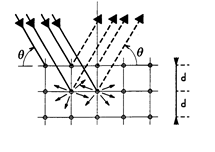
Bragg’s law for diffraction
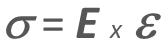
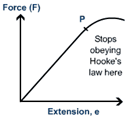
Hooke’s law for stress and strain
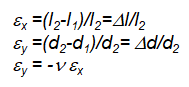
Poisson’s equations

X-ray radiation was discovered by the German physicist Wilhelm C. Röntgen in 1895. X-ray is electromagnetic radiation with much shorter wavelength than visible light and by that more energetic.
This extra energy in the X-rays helps us to penetrate 5-10 micron in to the surface of our steel sample. If our material has crystalline structure we will get diffraction with the help of the crystal planes. Here we use Bragg’s law for diffraction. If we can assume a plane stress state and send our x-ray beam into the surface with different inclination angles, we can measure the differences in crystal lattice plane distance in different angles towards the surface.
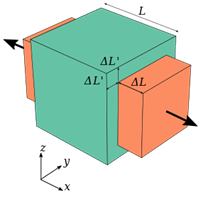
The distance between crystal panes in different angles towards the surface is dependent of the stress- and strain condition. Here we use Poisson’s equation. If we pull a cube, it will not only be longer but also thinner.
It would be optimal if we could measure the crystal planes perpendicular towards the surface. However, we can’t incline our beam that much. Instead we do different inclination angles and extrapolate. Then we will get our information of how much the crystal structure will strain compared to stress free state.
Then we will use Hooke’s law and multiply our strain with Young’s modulus, and the stress is there.
Sounds quite simple, doesn’t it?
However, we need to understand that we measure extremely short distances, so we need extreme accuracy!